
My project focuses on the problem of prevalence of STDs in Young Adults.
Things to Know:
STDs in Young Adults is a widespread problem affecting youth typically ages 15-24. This age group makes up over one quarter of the sexually active population, and accounts for half of the 20 million new sexually transmitted infections in the US every year. Some reasons young adults cannot protect themselves are:lack of knowledge or sex education regarding STDs or safe sex practices, lack of accessible safe sex resources, inadequate partner communication, and stigma. This problem is serious and growing. According to the World Health Organization there are approximately 367 million new infections every year, and more than 1 million STDs are acquired every day. In addition, there are serious implications beyond the instant infection. Some STDs can increase risk of contraction of HIV, HPV can cause cervical, and gonorrhea and chlamydia are major causes of pelvic inflammatory disease and infertility in women. If left unattended this problem will spread. Young adults make up a large sum of the cases of sexually transmitted diseases; therefor, they are a large component of the issue. New STDs can arise at anytime and without education or awareness the problem is likely to spread.
Risk and Protective Factors:
There are many factors that either put young adults at further risk of contracting STDs. Risk factors include: age, gender, substance use, socioeconomic status, race/ethnicity, unprotected sex, multiple partners, and a health history of STDs.
Age is a risk factor for STD contraction simply by the fact that the age group 15-24 accounts for half of all new STDs. If you are female in this age group you are also at a higher risk. Women suffer more frequently from serious STD complication than men do. Some complications include pelvic inflammatory disease, ectopic pregnancy, and infertility. In addition, certain racial and ethnic groups have higher rates of STDs. These groups include: African Americans, Hispanics,American Indian, and Alaskan Native populations.This is in part due to correlation with determinants of health status like poverty, access to health care, and medical treatments.
Substance use is also a risk factor as it can alter sexual behavior and increase high-risk sexual activity. Substance use is a prevalent activity in the young adult age range, making it more likely that they will partake in this activity.
The socioeconomic status of the young adult will influence whether or not he/she has access to healthcare for treatment or preventative services. The more impoverished someone is the more compromised their healthcare access will be. This can be due to ability to afford insurance, living location, transportation needs, and more.
An obvious but very important risk factor is having unprotected sex or sex with multiple partners. Lack of protection or improper and inconsistent use of protection increases likeliness of contraction. Non-barrier contraceptives should be accompanied by using a male or female condom. Having more than one partner also increases your chances of encountering a partner who is infected. If multiple partners is something that cannot be altered, young adults should look to improve their communication skills with one another. Also, having a history of STDs can increase the chance of someone contracting another STD in the future.
So how can young adults protect themselves from these risks? Well, there are many protective factors regarding STDs as well.
Protective factors include: abstinence, vaccinations, monogamy, use of protection, regular screenings, and open communication between sexual partners.
Abstinence is the most reliable way to avoid infection, because STDs are contracted through sexual contact. If abstinence is not a viable option, young adults should make sure they are vaccinated against Hep B and HPV. Regular screenings and testings for STDs are one of the most important things you can do preventatively for your health. Also, making sure to use barrier contraceptives in junction with non-barrier contraceptives. These barriers can include dentals dams and male condoms.
Young adults should try to practice monogamy, as long-term mutually monogamous relationships with an uninfected partner are a reliable way to avoid STD infection. Practicing open communication about sexual health with new sexual partners is also a healthy practice.
Determinants of Health:
Many social determinants can influence young adults sexual health such as: transportation education, social support, access to health care, social status, place, housing, and food access.
Many young adults do not have adequate transportation to reach facilities to be tested for STD’s or receive barrier protection. This could be due to social status and poverty level of the individual or whether or not their housing is near accessible care.
Social support or alienation is a large determining factor as to whether or not groups of individuals will seek care. Sexual minority groups such as the LGBTQ community,can struggle to become health and productive adults due to stigma, discrimination, family disapproval, social rejection or violence. This increases STD transmission.
Poverty and unemployment are associated with residential instability, segregation and migration. As a result of this racism and segregation, minority population have suffered disproportionate poverty levels and lack of educational opportunities.
Systems Asset Map

This is a systems asset map for STIs in Young Adults and different: Non-profit, Federal Government, State Government, and Local Government organizations and agencies that are working to improve the world of sexual health in young Adults. There is a color coded key in the bottom right corner to identify which level of government is being indicated.
Solutions
My desired solution is to have increased educational advertising on campus regarding resources that are available for students, the importance of testing and other preventative measures, and also how widespread STIs are on our campus. In conjunction with this we also need to implement new services for our students through the student health center. Creating more online services provide the student with a sense of anonymity, comfort, and security in the process of testing and treatment. Online services can include online STI tests where the individual can order a testing kit to their place of residency, take the test within the privacy of their home, and return it by mail for their results. This will provide anonymity, convenience, and comfort to the student, which will increase their likeliness for getting tested and seeking out additional services. Because stigma surrounds STIs it is important that the student feels secure through the process.
Letter of Advocacy: You can be an advocate too!
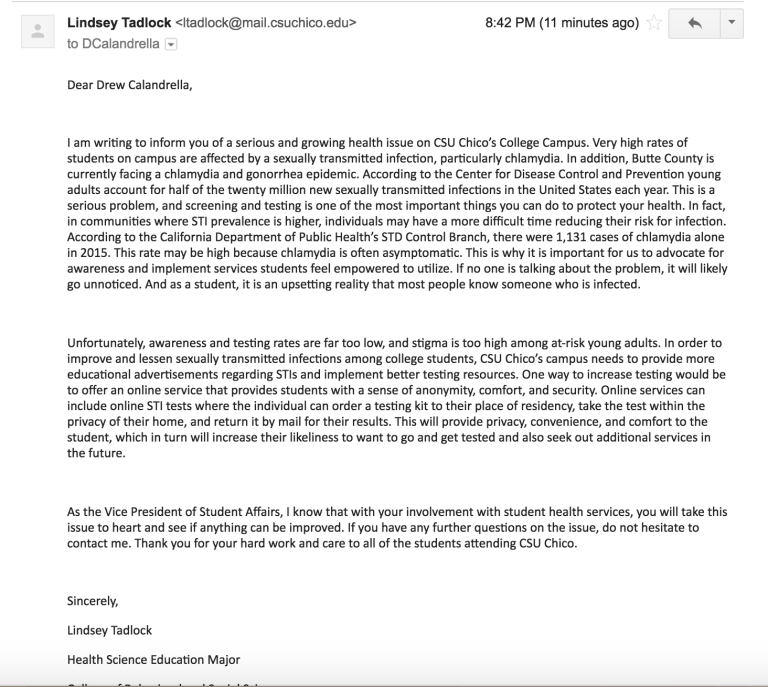
Above is a letter of advocacy regarding my program solution for my college campus. I e-mailed the Vice President of Student Affairs, Drew Calandrella, regarding my concerns and solutions. Anyone who wants to try and make a difference can find out who the administration is for their Student Health Center or Student Health Services and write an e-mail similar to this one. Voicing a concern will attract attention to an issue that may have no been noticed prior.
 LTadlock